
Mixing Lofi on the DT 770 PRO X: What Five Weeks Taught Me

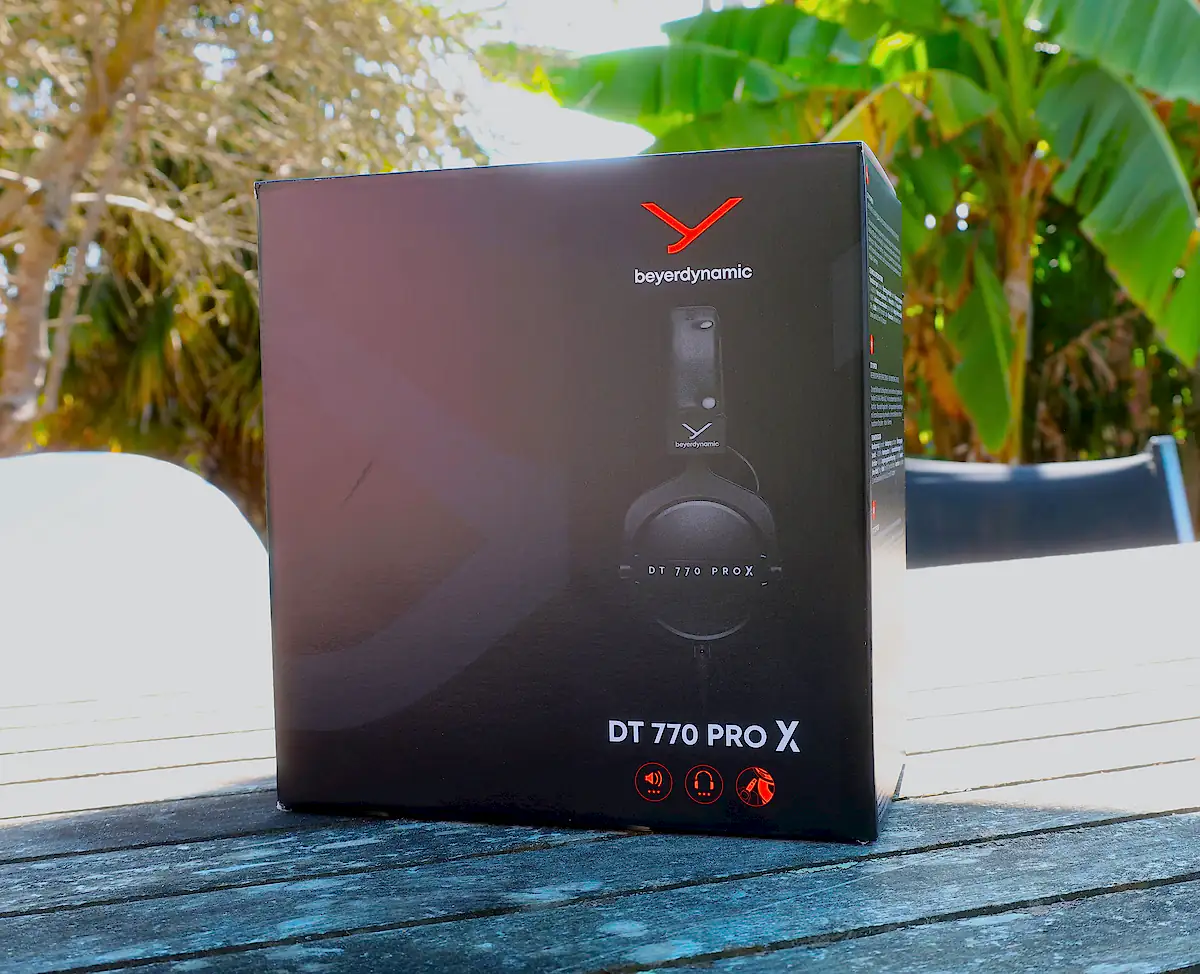
Ok, so here’s the thing. For years I mixed my lofi tracks on whatever headphones I had lying around, and I thought I was hearing my music. Then a pair of beyerdynamic DT 770 PRO X showed up at my door, I plugged them in, pressed play on one of my own tracks, and within the first evening I realised I had been mixing in 2D. This is my honest review of the DT 770 PRO X after five weeks of real sessions in my bedroom studio: what changed in my mixes, what I love, and the three things that bug me.
Transparency first, homies: beyerdynamic sent me this pair for free. They did not ask to read this article before it went live, they did not get any approval rights, and nobody told me what to write. Every observation below comes from notes I took right after my own sessions. The Thomann link further down is an affiliate link, so if you buy through it Widen Island gets a small commission at no extra cost to you.
The quick verdict
- My score: 9.5 out of 10. I was tempted to say 10, but the comfort caveats below keep me honest.
- Best for: bedroom producers who mix on headphones and want to actually hear the whole frequency spectrum, especially if you are coming from an older or cheaper pair.
- The standout: depth and detail. Things I had never noticed in my own tracks were suddenly right there.
- Not for you if: you want a soft, pillowy consumer headset to lounge in all day without music.
What the DT 770 PRO X actually is
Quick facts before the feelings. The DT 770 PRO X is a closed-back studio headphone from beyerdynamic, the German brand behind the classic DT 770 PRO that you have probably seen on half the desks in every studio photo ever. The PRO X version uses their STELLAR.45 driver at 48 ohms, which means it is designed to be driven from normal devices like a laptop or an audio interface without needing a big dedicated headphone amp. It weighs around 305 grams without the cable, and the big upgrade over the classic model is the detachable cable with a locking mini-XLR connector. You get a 3 metre straight cable with a 3.5 mm jack and a screw-on 6.3 mm adaptor.
That’s the spec sheet. Now let me tell you what it sounds like in a real lofi session, because that’s the part that matters.
Evening one: from 2D to almost 3D
The very first thing I wrote down, before I even had an opinion, was this: there is a real deepness to the sound. Everything sounded broad and wide, bigger than on the regular headphones I was used to. Before, my tracks felt flat, like a picture. On these they felt almost 3D, like the sounds had actual positions in a room.
For lofi that matters a lot. So much of our music lives in the space between the elements: the tail of a reverb, the width of a dusty sample, a soft Rhodes sitting slightly to the left. If your headphones squash all of that into the middle of your head, you are basically mixing blind and hoping it translates. On the DT 770 PRO X, the space is something you can hear and make decisions about.
You hear the whole spectrum (and all the little details)
After a few sessions, the word that kept coming back in my notes was details. On one session I listened for a few hours to a track I’m still working on, and what struck me was how much of the spectrum I could hear at once. The lows, the mids where all the jazzy chords live, the air on top. Nothing was hiding. And when you are in the zone, that clarity is really addictive, because every small move you make on a fader or an EQ, you can actually hear it.
By the end of the test period my summary was simple: there is more clarity across the frequencies, everything is crystal clear, and you hear more of the different parts of the spectrum. That is the big, big advantage of this headset, and it is the reason my score is where it is.
The A/B test that sold me
This is my favourite discovery, and it’s something you can steal for your own workflow. I started doing some A/B testing with FabFilter Pro-Q 3, switching between my EQ presets on the same sound. On the headphones I used before, a lot of those presets sounded kind of the same to me. I would pick one mostly on vibes.
On the DT 770 PRO X, I could really clearly hear the differences between each preset, much more than with my old pair. It made it way easier to decide which preset I preferred and which ones actually added something to the track versus just changing it. The difference is huge.
My tip: if you get a pair of proper studio headphones, do this A/B exercise in your first week. Take one bus, a few EQ or saturation presets, and flip between them. It trains your ears on the new headphones faster than anything else, and it shows you how many decisions you were making on guesswork.
If you want to go deeper on EQ for lofi, our dynamic EQ guide for lofi hip hop pairs really well with a pair of headphones that lets you hear what the EQ is doing.
My old tracks got exposed
Ok, this one hurt a little bit. I sat down and listened to an older track of mine, one I made long before these headphones arrived. And right away I noticed the bass sounding quite muddy in the mix. Not clean at all. It has a kind of charm, I will give my old self that, but I don’t think it’s helping the track.
It wasn’t only the bass. I could hear levels that were off: some elements too loud, others buried. Overall the mix felt quite off once I listened on the DT 770 PRO X. And the funny part is that I could hear all of it even with the headphones plugged directly into my laptop, no sound card in between.
This is honestly the most useful thing a pair of studio headphones can do for you. Not making your music sound nice, but showing you where it isn’t right yet. If you have a folder of old beats, listen back to them on a revealing pair. It’s humbling, but you will learn more from that hour than from a month of tutorials.
Harsh presets don’t punish your ears as much
Here’s one I did not expect to write about. I like to play around with effects and stack tons of them on top of each other, and sometimes I end up clicking through presets. You probably know the moment: you load a preset that is completely crazy, super loud, heavy distortion, and it hits your ears right away. Usually that hurts.
With the DT 770 PRO X it can still be unpleasant, of course, and you still want to turn it down fast. But it feels like these handle that scenario better. I didn’t feel hurt as much as I did with my previous headsets. When you spend your evenings experimenting with sound design, that makes a real difference to how tired your ears feel at the end of the night.
If you are into the experimental FX side of things, the free Chance plugin by Friendgineer Labs is a fun one to test this with. Please turn your volume down first 😉
Comfort: really good, with two honest caveats
For a mixing headset, the DT 770 PRO X is very comfortable. No compressed-ears feeling like I get from some other studio headphones. On one session I wore them for a long stretch while working on a track and I didn’t even notice I had them on. When you are in the zone, that is exactly what you want: the headphones disappear and it’s just you and the mix. Even after an hour or more I didn’t feel like taking them off.
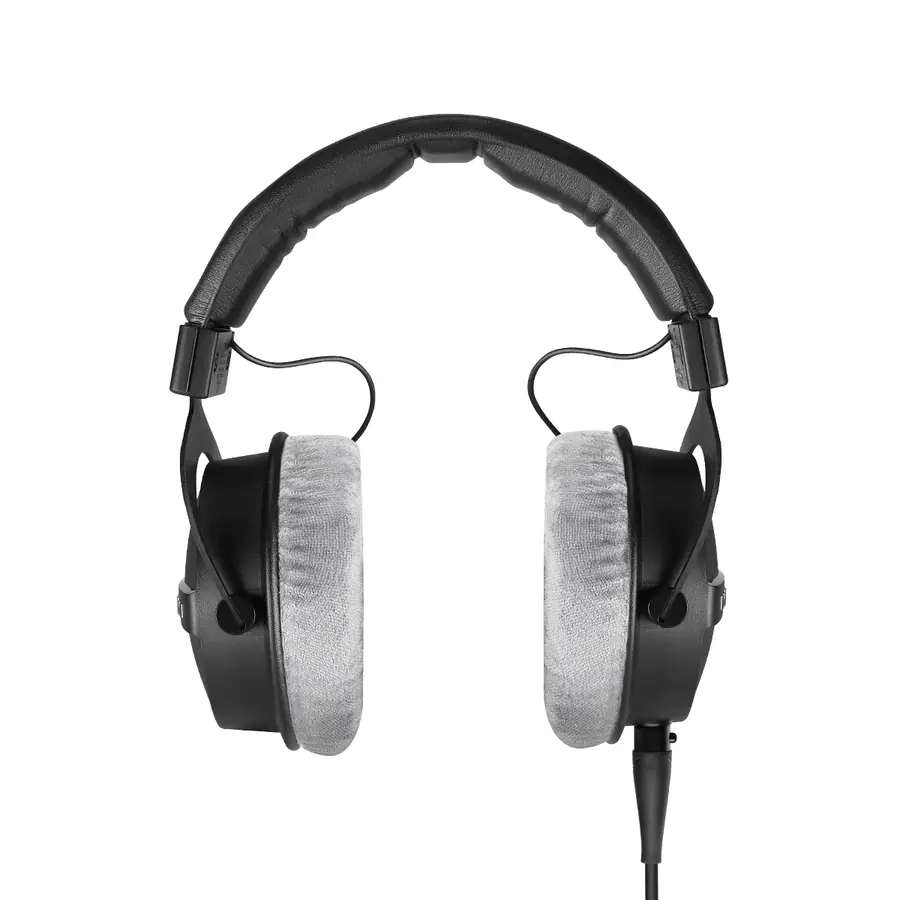
They are also very lightweight, which you feel most on long sessions and when you move around with them.
Now the caveats, because a review without them is just an ad:
- After a while you do want to take them off. Like every headset I have ever owned. They don’t have the softness of a comfy consumer headset. To be fair, those are not made for mixing, but if you expect lounge-chair softness you won’t get it here.
- The discomfort comes sooner when you’re not listening to anything. This one surprised me. When I kept wearing them without music playing, I started to feel the discomfort sooner than when I was mixing or listening. It’s not like they hurt fast. I think it’s partly about focus: when the music is on, my attention is on the sound, and when it’s off, my attention goes to my head. Still, worth knowing if you tend to leave headphones on between sessions.
Build quality: looks thin, feels solid
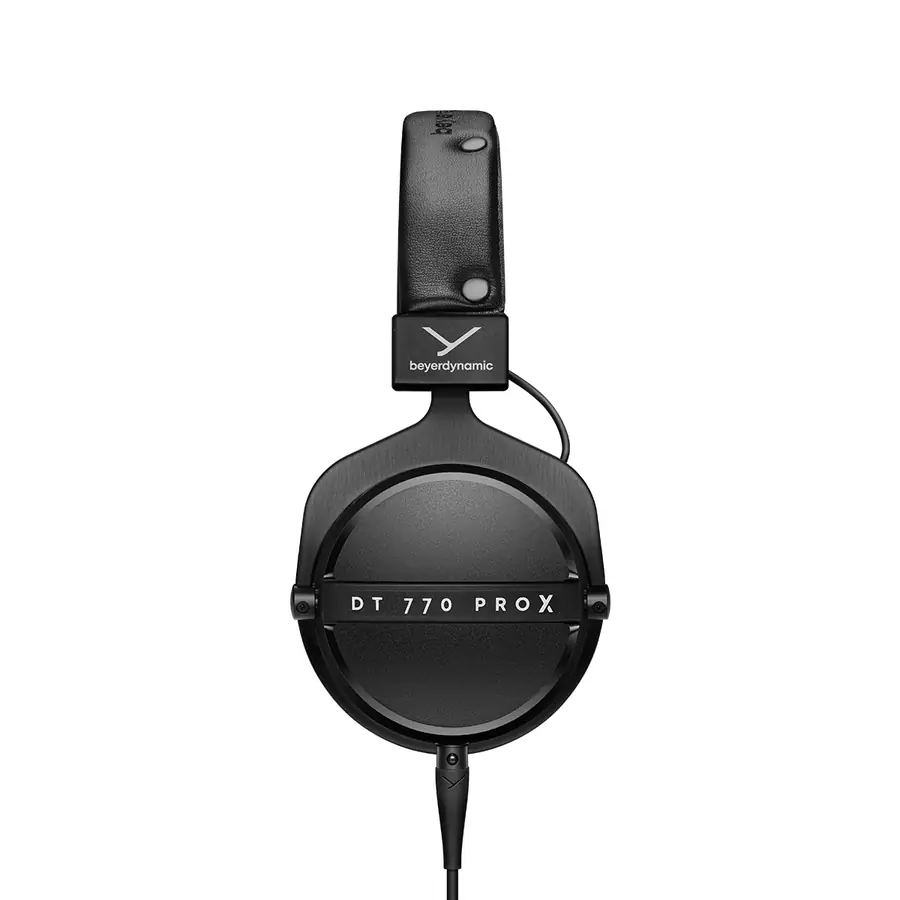
First impression when you look at them from the side: the arms look kind of thin, maybe a bit fragile in some ways. That’s my third criticism, and it’s purely an aesthetic one. Because in the hand and on the head, they feel really solid. I wouldn’t expect these to break, even though they look slim on the side. After five weeks of putting them on, taking them off and packing them away, nothing feels loose or cheap.
They also come with a little pouch in the box, which sounds like a detail but is very practical.
The detachable cable is a big deal
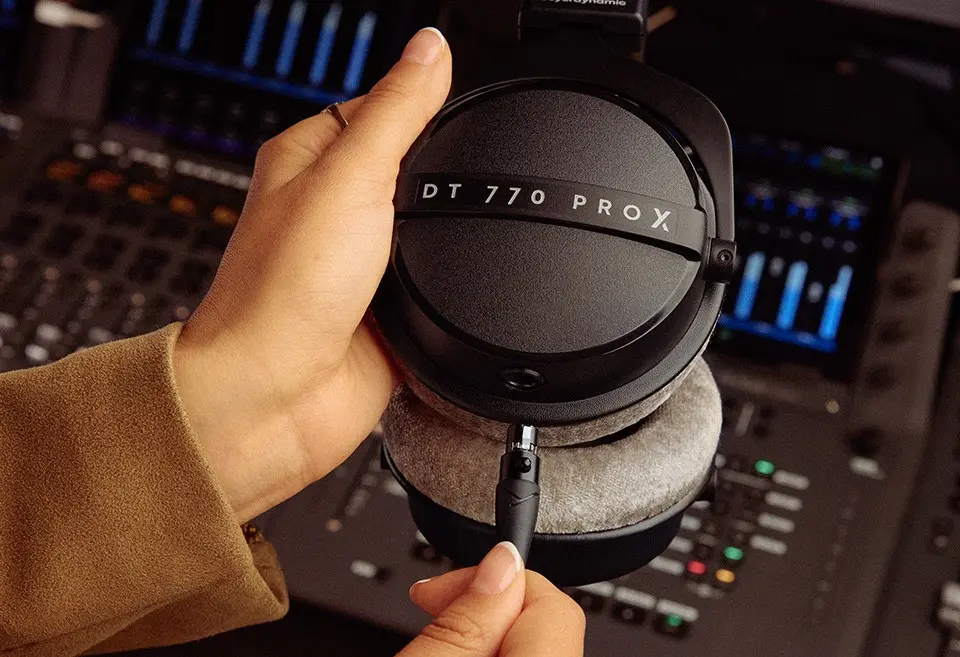
This is the headline feature of the PRO X versus the classic DT 770 PRO, and I love it. When I travel or move around, the fact that I can unplug the cable from the headset itself is really, really cool. It’s the first time I’ve seen this on one of my headsets. You coil the cable, the headphones go in the pouch, done. No more cable getting bent at the base because it’s permanently attached.
The cable itself also feels really good quality. It’s the kind of part you forget about until it fails, and on this pair I don’t expect it to.
48 ohms, my Apollo Twin, and which impedance is right for you
Quick word on impedance, because it confuses a lot of people (it confused me for years). The ohm number tells you how much power a headphone needs to sound its best. Low impedance gets loud and full from weak outputs like a phone or a laptop. High impedance needs a stronger output, like a good audio interface or a dedicated headphone amp, but rewards you with a lot of control when it gets that power.
The pair beyerdynamic sent me is the 48 ohm version, which is the only impedance the DT 770 PRO X comes in. In my studio I run them through my Universal Audio Apollo Twin, and that’s where almost all of the sessions in this review happened. The Apollo drives them with plenty of clean headroom, so I never felt I was missing volume or punch.
If you are shopping in the wider DT 770 family, here’s how I’d think about it:
- DT 770 PRO X (48 ohms): the flexible one. Loud enough from a laptop or phone, and still great on an interface. The best pick if your setup moves around, or if you want one pair for the studio and the train.
- Classic DT 770 PRO, 80 ohms: the long-time studio standard, made to be plugged into an audio interface. Fixed cable though.
- Classic DT 770 PRO, 250 ohms: for a dedicated headphone amp or a strong interface output. Not the one for a laptop-only setup.
- Classic DT 770 PRO, 32 ohms: made for phones and portable players.
For a studio built around an interface like my Apollo, the 48 ohm PRO X fits really well. For more mobile setups, it’s honestly the safest choice of the whole family, because it doesn’t need the extra gear to sound good.
Laptop or audio interface?
Being lazy, I sometimes plug them straight into my MacBook instead of my Apollo. And it still sounds pretty good. That’s the point of the 48 ohm design: you don’t need extra gear to get a good sound out of them. But for sure there is a little difference compared to a proper output, and you can hear it.
So my advice: if you have an audio interface, use it for mixing. If you are on the go with just a laptop, don’t worry, they will still sound really good, you just won’t get 100% of what they can do.
What I don’t love (all in one place)
I promised myself this review would have real criticisms, so here they are, collected:
- After a long stretch you still want to take them off. Comfortable for studio headphones, not consumer-headset soft.
- Wearing them with no music on, the discomfort shows up sooner.
- They look thin and a bit fragile from the side. They aren’t, but they look it.
Plus one small note: straight out of a laptop they sound good, with a little less than through an interface. That’s normal for any studio headphone, just don’t judge them on your laptop jack alone.
Who should buy the DT 770 PRO X
- Bedroom producers who mix on headphones. If you don’t have a treated room with monitors (hello, most of us), this is the tool that lets you hear what your mix is doing.
- Anyone upgrading from an older or cheaper pair. This is where the jump is biggest. If you come from something less modern or a budget model, you will hear a huge difference right away.
- Producers who move around. Lightweight, detachable cable, a pouch in the box. It’s a studio headphone that travels well.
- Sound design nerds. If you stack effects and click through wild presets, your ears will thank you.
Who should skip it
- People who want a soft, relaxed headset to wear all day for casual listening, calls and gaming. That’s a different product category.
- If you are still on a very tight budget, our budget headphones guide for lofi producers has cheaper options to start with. Come back to the DT 770 PRO X when you are ready for the upgrade.
Three things to do in your first week with them
- Run the A/B preset test. Pick one EQ or saturation plugin and flip through presets on the same sound. Learn what the headphones reveal.
- Listen back to an old mix. Pick a track you made on your previous headphones. Write down what sounds off: muddy bass, levels, harsh highs. That’s your to-do list for future mixes. Share what you find in the Widen Island Discord, we love a before-and-after.
- Use a proper output for mixing. Laptop jack for the train, audio interface for the actual decisions.
Final verdict: 9.5 out of 10
Honestly, I was going to give these a 10. They are an amazing piece of gear, and I most definitely hear a big difference in my own sessions: depth I didn’t know my mixes were missing, detail across the whole spectrum, and a clarity that makes EQ decisions faster and more confident. The detachable cable and the light build make them easy to live with day to day.
But the comfort caveats are real, and a 10 should mean nothing to complain about. So it’s a 9.5. If you are mixing lofi at home on older or cheaper headphones, this is one of the upgrades that changes what you actually do with your music, not just how it sounds.
You can check the current price of the beyerdynamic DT 770 PRO X on Thomann.
Big thanks to the beyerdynamic team for trusting a small lofi blog with this pair. And to you guys reading: if you have questions about the DT 770 PRO X or want me to test something specific on them, come ask me in the Widen Island Discord. Go make something beautiful, homies <3
/Edwin
Frequently asked questions
Is the DT 770 PRO X good for mixing lofi?
Yes. In my sessions the biggest strengths were depth, stereo width and detail across the whole frequency spectrum. It exposed a muddy bass and off levels in an older mix of mine that I had never noticed on my previous headphones.
Do I need a headphone amp for the DT 770 PRO X?
No. It’s a 48 ohm headphone designed to run from normal devices. Straight from a MacBook it still sounds good, but I could hear a difference compared to a proper audio interface output, so use one for mixing if you have it. I use mine through a Universal Audio Apollo Twin.
Is the DT 770 PRO X comfortable for long sessions?
For a studio headphone, very. It’s lightweight and I could wear it through long mixing sessions without noticing it. It isn’t as soft as a consumer headset, and I felt discomfort sooner when wearing it without music playing.
What is the difference between the DT 770 PRO and the DT 770 PRO X?
The most practical difference is the detachable cable with a locking mini-XLR connector on the PRO X, which makes it easier to travel with and means a damaged cable can be replaced. The PRO X also uses beyerdynamic’s STELLAR.45 driver at 48 ohms.


